platform-engineering-beyond-devops
Why Engineering Teams Still Feel Slow
Artificial Intelligence has changed software engineering faster than anyone expected.
Developers can generate code in seconds, automate repetitive tasks, and solve technical problems with tools that didn't exist just a few years ago.
So why do many engineering teams still feel like they're moving too slowly?
The answer isn't that developers need better AI.
It's that most engineering organizations are still fighting a different problem: engineering friction.
f you ask developers what slows them down, the answers are rarely about writing code.
Instead, you'll hear things like:
- Waiting for code reviews.
- Searching for outdated documentation.
- Requesting infrastructure access.
- Navigating deployment processes.
- Switching between too many tools.
- Waiting for another team to unblock them.
None of these delays seem significant on their own.
But together, they quietly consume hours every week and across an organization, those hours become one of the biggest hidden costs in software delivery.
For years, engineering leaders focused on increasing developer productivity by introducing better tools.
Today, the conversation is changing.
The most successful organizations are asking a different question:
How do we build an engineering system where developers can spend more time creating value and less time navigating complexity?
That question has become the foundation of Platform Engineering.
Unlike many technology trends, Platform Engineering didn't emerge because someone invented a new framework.
It emerged because modern software organizations became too complex for every product team to manage infrastructure, security, deployments, and operational tooling independently.
Instead of expecting every developer to become an infrastructure expert, organizations began investing in platforms that simplify the engineering experience.
Because in the end, productivity isn't just about writing code faster.
It's about helping great work move through the system with as little friction as possible.
Why DevOps Was Never the Final Destination
DevOps changed the way software is built.
It removed barriers between development and operations, introduced automation into software delivery, and made continuous integration and continuous deployment part of everyday engineering.
Without DevOps, modern cloud-native software wouldn't exist in the form we know today.
But success brought a new challenge.
As organizations scaled, engineering environments became dramatically more complicated.
A developer joining a modern engineering team no longer interacts with just a code repository.
They're expected to understand cloud infrastructure, Kubernetes, CI/CD pipelines, security controls, monitoring systems, infrastructure templates, secrets management, internal APIs, and countless engineering tools.
Every one of these technologies solves a real problem.
Together, they can create a new one.
Cognitive overload.
Developers spend increasing amounts of time understanding how to work inside the system instead of solving customer problems.
That's where Platform Engineering enters the picture.
Not as a replacement for DevOps—but as its natural evolution.
If DevOps asked:
"How can we automate software delivery?"
Platform Engineering asks:
"How can we make software delivery dramatically easier for developers?"
The difference is subtle, but important.
DevOps focuses on collaboration and automation.
Platform Engineering focuses on developer experience.
Instead of asking every engineering team to solve the same infrastructure challenges repeatedly, platform teams create reusable internal capabilities that every developer can use.
The objective isn't to hide infrastructure.
It's to reduce unnecessary complexity.
When developers can provision environments, deploy applications, discover documentation, and follow secure engineering practices through consistent self-service workflows, they spend less time navigating systems and more time delivering products.
That shift changes the role of the platform itself.
It is no longer just infrastructure.
It becomes an internal product designed for one specific customer:
The developer.
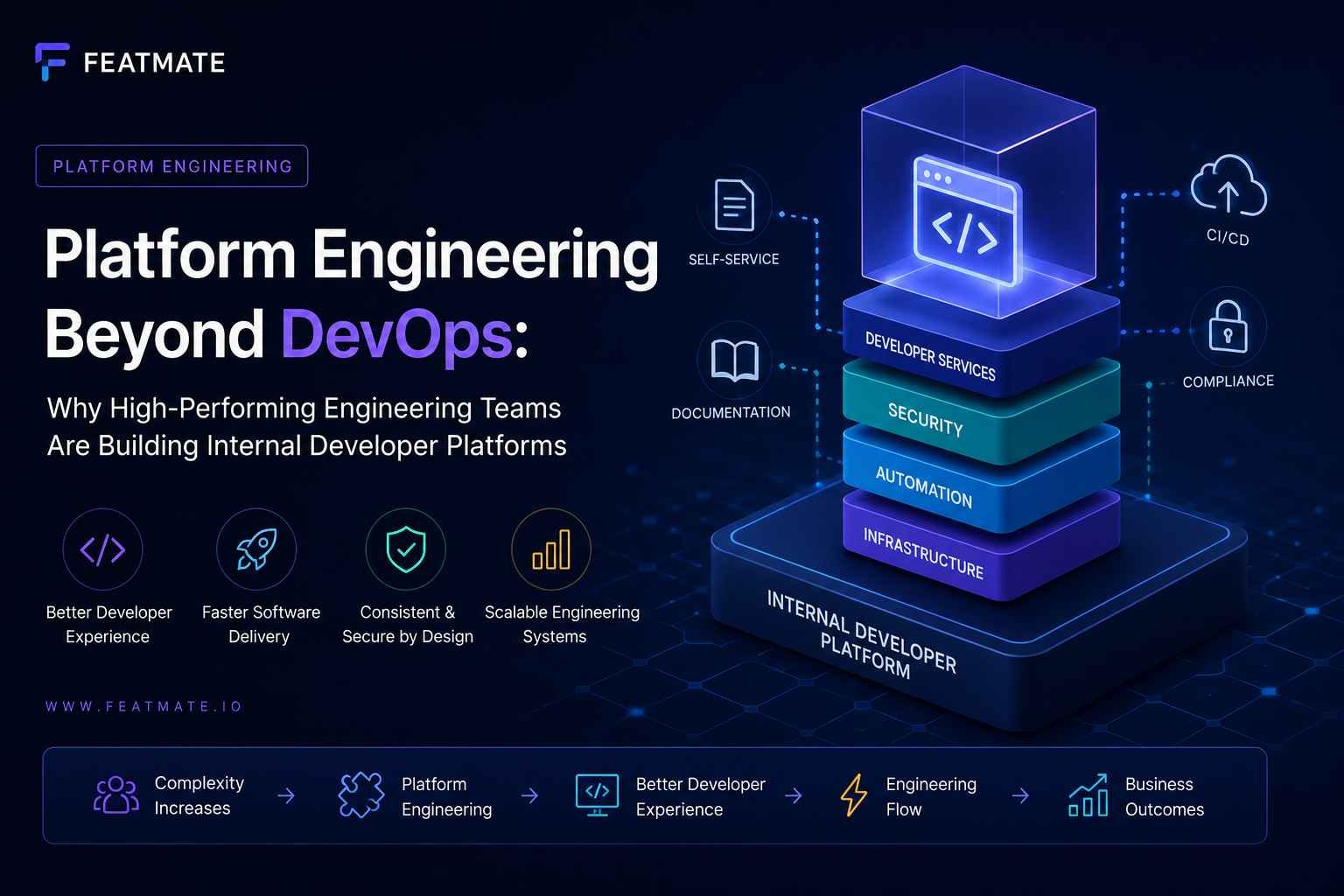
And once engineering organizations begin thinking this way, the next logical step is building an Internal Developer Platform a platform that standardizes workflows, reduces friction, and creates a consistent engineering experience across every team.
What Platform Engineering Really Means
One of the biggest misconceptions about Platform Engineering is that it's simply "DevOps with a new name."
It isn't.
DevOps is a way of working.
Platform Engineering is a way of designing the engineering experience.
The difference becomes clear when you look at who the customer is.
In traditional infrastructure teams, the focus is often on systems, servers, clusters, or cloud resources.
Platform teams think differently.
Their customer is the developer.
Every decision begins with one question:
"How can we make it easier for engineers to build, deploy, and operate software?"
That shift changes priorities.
Instead of creating more documentation, platform teams build self-service capabilities.
Instead of asking developers to understand every infrastructure detail, they provide opinionated workflows that remove unnecessary decisions.
The goal isn't to reduce flexibility.
The goal is to reduce cognitive load.
Every additional decision costs attention.
Which deployment template should I use?
Where is the documentation?
Who owns this service?
How do I request production access?
Which security policy applies?
These small interruptions rarely appear on engineering dashboards, yet they quietly reduce productivity every day.
Platform Engineering treats those interruptions as design problems—not developer problems.
Success isn't measured by how much infrastructure exists.
It's measured by how little developers need to think about it.
When developers can focus on solving customer problems instead of navigating internal systems, engineering organizations naturally become faster, more reliable, and easier to scale.
Internal Developer Platforms: Building Engineering Systems That Scale
The practical outcome of Platform Engineering is the Internal Developer Platform (IDP).
An IDP isn't just another tool in the engineering stack.
It's a unified experience that brings together infrastructure, deployment, security, documentation, and operational workflows into a consistent developer journey.
Think of it this way.
Instead of asking every product team to build its own deployment pipeline, infrastructure templates, monitoring setup, and security standards, the platform provides those capabilities once—and every team benefits.
One of the most valuable concepts inside modern platforms is the Golden Path.
A Golden Path is the recommended way to build and ship software inside an organization.
It isn't about restricting engineers.
It's about making the safest and most efficient path the easiest one to follow.
That consistency creates benefits across the entire organization.
New engineers become productive faster.
Deployments become more predictable.
Operational risk decreases.
Knowledge is easier to share.
Engineering teams spend less time reinventing processes and more time delivering value.
This also has a direct impact on Developer Experience (DevEx).
Great developer experience isn't about giving engineers more tools.
It's about removing unnecessary obstacles.
Can developers create environments without opening tickets?
Can they deploy confidently without waiting for multiple approvals?
Can they quickly discover internal services and documentation?
Can they spend most of their day solving customer problems instead of operational tasks?
These questions matter because every unnecessary interruption slows engineering flow.
The organizations leading this transformation—including companies like Spotify, Netflix, and Google didn't build internal platforms because infrastructure was difficult.
They built them because developer time became one of the most valuable resources in the business.
The biggest mistake many organizations make is starting with technology.
They evaluate Backstage, Crossplane, Kubernetes, Terraform, or dozens of other tools before understanding what developers actually need.
The strongest platforms don't begin with software.
They begin with listening.
Every capability inside an Internal Developer Platform should answer one simple question:
"Does this remove friction from the developer's daily work?"
If the answer is yes, the platform is creating value.
If the answer is no, it's simply adding another layer of complexity.
The Featmate Engineering Flow Framework
Throughout this article, one idea has remained consistent:
Engineering productivity is not determined by how fast developers write code. It's determined by how easily valuable work moves through the engineering system.
At Featmate, we think about this through a simple model called the Engineering Flow Framework™.
| Engineering Complexity ↓ |
| Platform Engineering ↓ |
| Internal Developer Platform ↓ |
| Developer Experience ↓ |
Engineering Flow ↓ |
Business Outcomes |
Every growing engineering organization becomes more complex over time.
There are more engineers, more services, more cloud resources, more security requirements, and more operational processes.
Complexity is inevitable.
Friction is not.
Platform Engineering exists to absorb that complexity before it reaches developers.
An Internal Developer Platform turns engineering standards into reusable services.
Developers no longer need to understand every infrastructure decision or operational detail.
Instead, they work with consistent workflows that make the right path the easiest path.
That improves Developer Experience.
Better developer experience creates uninterrupted engineering flow.
And engineering flow produces better business outcomes.
Instead of asking developers to work harder, engineering leaders should ask a different question:
"Where does valuable work stop moving?"
Maybe it's waiting for infrastructure.
Maybe it's a manual approval.
Maybe it's inconsistent deployment processes.
Maybe it's poor documentation.
Every interruption is a signal that the engineering system can be improved.
The organizations that consistently deliver software faster aren't simply hiring better engineers.
They're building better engineering systems.
That's the real competitive advantage Platform Engineering creates
Conclusion
For years, engineering leaders focused on optimizing individual productivity.
Today, the challenge is different.
The highest-performing engineering organizations are optimizing the system itself.
DevOps transformed the way software is delivered.
Platform Engineering is transforming the way software is built.
By reducing cognitive load, standardizing workflows, and creating self-service experiences, Internal Developer Platforms allow developers to spend less time navigating complexity and more time delivering value.
Artificial Intelligence will continue to change software engineering.
But AI alone won't solve engineering friction.
Without a well-designed platform, faster code generation simply moves bottlenecks further downstream.
The future belongs to organizations that combine AI with great engineering systems.
Because sustainable engineering productivity isn't created by asking developers to move faster.
It's created by removing everything that slows them down.
Platform Engineering is no longer just an infrastructure initiative.
It's becoming a business strategy for organizations that want to build software faster, scale confidently, and create an engineering experience where great work can happen every day.
Building modern software is no longer just about choosing the right technologies.
It's about creating engineering systems where developers can focus on solving real customer problems instead of navigating operational complexity.
If your organization is exploring Platform Engineering, Internal Developer Platforms, or ways to improve developer productivity, follow the Featmate Blog for practical insights, research-driven frameworks, and engineering strategies designed for modern software teams.
Key Takeaways
- Platform Engineering is an evolution of engineering systems—not a replacement for DevOps.
- Internal Developer Platforms reduce complexity by creating consistent, self-service workflows.
- Developer Experience is becoming a strategic advantage for engineering organizations.
- AI increases engineering capability, but Platform Engineering removes engineering friction.
- The most successful engineering teams optimize flow, not just developer output.
Tags
Categories (22)
- All (27)
- Network Administration (4)
- Virtualization (2)
- DevOps (6)
- Backup (0)
- Web Hosting Control Panel (0)
- Cloud Management (0)
- Server Management (1)
- Database (1)
- Cybersecurity (1)
- Programming & Tech (0)
- Artificial Intelligence (AI) (9)
- Engineering Productivity (1)
- Platform Engineering (2)
- AI Strategy & Consulting (0)
- LLM Integration & Application Development (0)
- AI Agents & Workflow Automation (0)
- Machine Learning Engineering (0)
- Model Training & Fine-Tuning (0)
- MLOps & AI Infrastructure (0)
- Data Engineering for AI (0)
- AI Security, Safety & Compliance (0)
- AI Delivery & Fractional Leadership (0)


Join as a freelancer or client
Join as a Freelancer
Join as a Client